

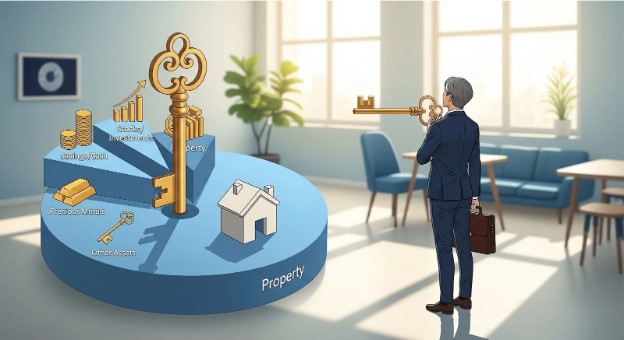
It is easy to have real estate take over your financial universe if you own property (or are on your way to owning it). Property is physical, it is known, and it is comfortably long-term robust, depending upon your market. But comfort can easily become a narrow focus, and it is this focus that catches most investors off guard.
It is not a question of the property, but determining what percentage of your net worth should be invested in areas other than property. It is about developing a strategy capable of accommodating curveballs such as rate changes, vacancies, repairs, or personal life changes requiring urgent decisions on cash. Making choices offers alternatives, and when it comes to stress, alternatives are the solution.
Realize the concealed concentration dangers of property
Another myth is that because you hold two properties, you are diversified. In fact, you may still be concentrated even if the two properties rely on the same drivers (the same city, the same kind of tenant, the same interest-rate cycle). The real estate market also has lumpy risks—high costs do not come in tidy monthly packages.
There are usually a few ways in which property concentration manifests. You may have a large portion of your net wealth vested in a single suburb, loan structure, or single tenant market. As long as things are good, it seems insignificant; but when things change, it becomes everything.
The concentration risks that should be observed include:
- Liquidity risk (you cannot sell a bedroom to pay a bill)
- Leverage risk (debt increases both returns and stress)
- Risk of timing (you might be required to access cash when the market is slow)
- Operational risk (vacancy, insurance shocks, repairs)
Make sure you check your liquidity requirements before you choose a number
Liquidity is merely the speed at which you attain access to cash without making any big swings. This is the largest reason why many investors possess valuable non-property assets. Even high performers might create cash strain when costs stack up or when your revenue goes wrong at the wrong moment.
The most useful way to think of it is to divide your money into three time horizons: now, soon, and later. “Now” provides emergency coverage and life surprises. “Soon” is used to deal with future objectives such as renovations, deposits, or a career break. Your long-term wealth building is “later,” and in that case, property is often a shining star.
When you are heavily property-weighted, it is worth asking whether you can afford to pay all your total life and property expenses, without selling anything, over a period of between 6 and 12 months. If the reply is no, then that is a great reason to increase your share of outside property.
Determine the amount of leverage that is increasing your exposure
Leverage alters the entire discussion. The same-value property portfolio can be owned by two people, whereby the one that has more debt is taking much more risk. As rates increase, it strains your cash flow; as valuations decline, your equity buffer declines.
Rather than asking about property only as a percentage of net worth, also ask: what is my reliance on borrowing terms? If the portfolio performs when rates remain low, you might consider increasing your investment in other assets that are not related to property to serve as a shock absorber.
That does not imply that you should be scared of being in debt. It implies that you must respect the speed with which the math can change as repayment costs get higher, insurance plans rise, or rent falls short of expenses.
Be content with a plain outline (not being too concerned with accuracy)
The reason why most people are stuck is that they desire the “right” percentage. The truth is that there is no universal right answer—there is a spectrum that suits you. An unambiguous structure will assist you in choosing a sensible goal that will not become a protracted argument.
These are the three general profiles to begin with:
- Heavy builder in property: 70% – 90% in property (they are generally earlier-stage, more risk-taking, with greater income stability).
- Balanced allocator: 50% – 70% in property (wants growth but appreciates flexibility and less volatility).
- Flexibility-first: 30% – 50% in property (liquidity or lifestyle choice or reduced leverage).
These are not rules, but guidelines. When you are highly leveraged, you might want to act like the next more conservative band in spite of the fact that you are an aggressive personality. You have to include reality in your balance sheet, not optimism.
Determine what constitutes outside property
Outside property is not a bucket of one. It may feature cash, stock/ETFs, bonds, superannuation/pensions, ownership of a business, or real stores of value. They will all act differently during a crisis and during a boom, thus it is desirable to act intentionally and not to fall into a default mode of doing what is easy.
Think in terms of function:
- Safety: cash cushions and assets with low volatilities in case of emergency.
- Growth: diversified investments which can compound as well as property.
- Optionality: assets that can be accessed without any compulsion to sell the property.
With the concept of outside property as a toolkit, making the allocation process more confident becomes easier. You are not taking money out of property; you are setting up propping beams around it.
An application in practice: developing flexibility using a small “liquidity sleeve”

Suppose you are doing well in real estate; however, you have observed that your financial life is stiffening. Your fines can find you in reactive decision making, such as a tenant issue, a strata surprise, or an interest-rate adjustment. The answer is a small “liquidity sleeve”—a piece of your net worth created simply to keep you in the right frame of mind and make you competent.
There are individuals who prefer that sleeve to be a combination of cash and an asset which is easier to sell as opposed to property. That might be broad-market investments (or other alternatives) depending on your preferences and risk profile. When you are looking at physical resources, you may come across opportunities such as Gold Coast silver bullion as a result of studying available smaller-ticket stores of value.
It is not the product that counts, it is the intention. If the sleeve helps you avoid selling property at a time when you are under pressure, then it is working.
And save yourself costly errors with a second opinion
It is sometimes difficult to know whether you are being wise or you are just not growing. That is when a systematic review can come in handy, in case you have a set of loans, future buying plans, or family requirements. An advisor will also be able to notice concentration risks that have become normalized with time.
To have a more personalized plan, you might want to talk to property advisory services that have a unified view of your portfolio, lending structure, and goals instead of dealing with each property decision separately. It is not about being told what to do, but rather ensuring that whatever you are deciding to do is in line with the life you are creating.
Summarizing everything (but not being complicated actually)
How much of your net worth, then, should be outside property? Enough to keep you liquid, flexible, and confident despite market volatility—and to ensure you are not dominated by any one market or loan cycle. That beginning is a hard cash buffer for many individuals, and then goes on to diversified non-property investment that suits their time horizon.
When you choose a range target (not a single ideal number), you can make alterations with the changes of life. That is what a sound strategy should be like: not strict, but purposeful.